The Danish National Archives holds a ground-breaking document proving that President Donald Trump is wrong about Greenland
In a high-security storage facility at the Danish National Archives (Rigsarkivet) is a 100 year old sheet of paper with an American promise about Greenland. This is the fascinating story which President Trump apparently does not know, but which is perhaps more relevant than ever.
In his eagerness to take over Greenland, President Trump appears to be under a delusion.
On more than one occasion, the President has contended that Denmark’s rights to Greenland can be disputed and that it remains a mystery why the World’s largest island is even part of the Kingdom of Denmark.
»People really don’t even know that Denmark has any legal right to it,« President Trump has argued. He recently reiterated that he does not believe that Greenland even belongs to Denmark.
»They say they have rights to it. I don’t know if that’s true. I don’t think it is, actually,« he said.
What Trump appears to have forgotten, not know or openly ignore is the fact that the Danish National Archives is home to a document which is more than 100 years old and contains a clear promise made by the USA. On the document is a highly significant signature, which helped ensure that Denmark gained sovereignty of the whole of Greenland.
Jyllands-Posten has been granted special access to see this historical sheet of paper.
Exceptional national importance
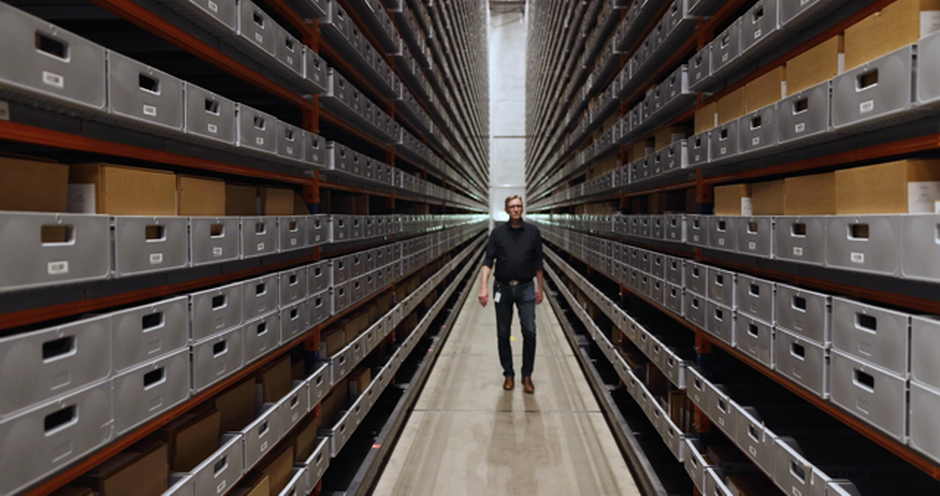
A steel door slides open with a loud clang as it is unlocked by Asger Svane-Knudsen, Special Consultant at the Danish National Archives. He takes us to a small storage facility in which the shelves are full of file boxes.
He takes out one of the boxes and lifts off its lid on which the letters »ENB« are written in red. The letters signify that the contents of the box are of »exceptional national importance« (»enestaaende national betydning«).
Normally, such documents are kept in one of the high-security storage facilities of the Danish National Archives which are not open to the public. Today is different, though.
Asger Svane-Knudsen puts on a pair of white gloves and carefully begins to unpack the contents of the box.
He first shows us a black leather folder with golden edges, neat italic writing, stamps and the Great Seal of the United States of America featuring the American bald eagle. This is the 1916 Treaty on Denmark’s sale of the Danish West-Indian Islands to the United States of America at the price of USD 25 million. It bears the signature of President Woodrow Wilson.
However, we are more interested in a fairly modest addendum to the Treaty; an addendum insisted upon by Denmark’s then Government and then Foreign Minister, Erik Scavenius (the Danish Social-Liberal Party). It takes the form of a separate additional declaration comprising eleven short typewritten lines on an ordinary sheet of paper placed in a brown envelope.
The paper has now yellowed, but there it not much else to indicate that the crucial document is more than 100 years old.
»It has only been taken out on very few occasions,« says Asger Svane-Knudsen and places the single sheet of paper on the table in front of us.
The last sentence is the essential part as that is where the USA promises »that the Government of the United States of America will not object to the Danish Government extending their political and economic interests to the whole of Greenland.«
It is dated in New York on 4 August 1916 and signed personally by Robert Lansing (1864-1928), the then Secretary of State of the USA, on behalf of the Government of the United States of America.
With a single stroke of a pen, the USA accepted that the whole of Greenland was Danish territory.
Paving the way for Denmark
Denmark had been trying to gain control of all of the enormous island ever since the 1880s, but had not been certain of success when Robert Lansing signed the declaration in 1916.
Denmark had in fact been colonising Greenland since 1721, establishing colonies along the coasts of Greenland, and polar explorer Knud Rasmussen had even set up a trading post as far to the north as Thule. However, further to the north was still an enormous area which was effectively considered no man’s land.
The Americans had already brought up the possibility of purchasing Greenland when purchasing Alaska from the Russian empire in 1867.
That is the very reason why the Lansing Declaration was ground-breaking, says Astrid Nonbo Andersen, Ph.D. and Senior Researcher at the Danish Institute for International Studies (DIIS).
»That was the first time that the USA acknowledged Denmark’s sovereignty of the whole of Greenland, and it started the entire process leading up to Denmark declaring sovereignty of the whole of Greenland in 1921,« she says.
»You could say that, at the end of the day, the USA found that access to the deep-water port of St. Thomas was more important than Greenland,« she adds with reference to one of the three West-Indian Islands.
Bo Lidegaard, historian and author, also confirms that the acceptance given by the USA helped pave the way for Denmark assuming full control over Greenland.
»The Americans effectively said that because Denmark was already established in Greenland, they would make an exception from the Monroe Doctrine [saying that the USA would not accept new efforts by European powers to control areas in the USA’s sphere of interest] and approved that Denmark extended its sovereignty to the entire island,« he says.
Fear of Germans in the Caribbean
Today it may appear odd that the USA made the three small West-Indian Islands a priority over the geographically crucial giant to the north. That is certainly the case right now as, being an important security policy pawn in the power struggle over the Arctic, Greenland has become a subject of President Trump’s urge to possess.
However, in 1916 the World was entirely different, Bo Lidegaard points out.
The USA had not yet become the superpower that the country is today, and in Europe blood was being shed in the trenches of World War I.
»I don’t think that the USA considered it to be a major concession at the time,« he says about the compromise.
The Americans were mainly interested in preventing Germany from gaining a foothold in the Caribbean. That was due to serious concern in Washington that the Germans would use the World War as an opportunity to occupy their small, neutral neighbour and thereby gain access to the Danish West-Indian Islands near the Panama Canal, which had opened a few years earlier.
»Lansing long resisted, but in the end the impatient President Wilson cut things short and accepted the condition,« says Ove Hornby, historian, in his 1980 book about the West-Indian colonies.
The dispute with Norway
When the guns fell silent after World War I, Denmark continued its endeavours to obtain international support for its claim for sovereignty over Greenland and did in fact obtain such support from several great European powers as the USA had already paved the way.
Only Norway objected to the Danish Government’s declaration in May 1921 saying that the whole of Greenland was now under Danish sovereignty.
For years, Norwegian whalers and sealers had hunted and had erected small weather stations in the more or less uninhabited Eastern Greenland, and the Norwegians were therefore of the opinion that the country belonged to Norway. The disagreements escalated to a long-standing dispute under international law, which culminated when Denmark brought an action against Norway before the International Court of Justice in the Hague to settle the matter once and for all.
The Lansing Declaration was produced in the proceedings, says Astrid Nonbo Andersen. It was one of several similar declarations issued by the Allies, the victors of World War I.
The final decision was made in 1933 in favour of Denmark, and the Norwegians subsequently left the east coast again.
Lars Løkke Rasmussen, the incumbent Danish Foreign Minister (the Moderates), recently referred to the judgment when he dismissed President Trump’s ideas about annexing Greenland.
»The status of Greenland has been fully clarified through international court rulings, including from a historical dispute with Norway. The rulings are clear, and they cannot be questioned,« he said.
The starting point of it all is the yellowed sheet of paper from 1916.
Back at the Danish National Archives, Asger Svane-Knudsen carefully puts all the documents back into the box and carries the box to a trolley fitted with a hatch and metal grid panels. He meticulously locks the padlock.
These documents are to be kept safe for all eternity.
This article was translated from Danish by certified translator Heidi Skriver Olsen.